Phimosis: Surgery and Possible Alternatives
Page co-author:
– Dr. Stefano Germani, Senior Physician (UOSD) – Fondazione Policlinico Tor Vergata, Rome.
– Dr. Stefano Germani, Senior Physician (UOSD) – Fondazione Policlinico Tor Vergata, Rome.
In cases of phimosis – a medical condition in which it is difficult or impossible to expose the glans of the penis because the foreskin is too narrow – surgery has for years been the standard way the medical profession has dealt with the condition. The surgical procedure for phimosis in adults is circumcision, i.e. the partial or total surgical removal of the foreskin, the fold of skin that covers the glans. Today, however, there are alternative therapies – such as Phimostop – that make it possible to treat phimosis without surgery.

On this page:
Surgery: what does it depend on?
The decision to have phimosis surgery by circumcision depends on the type and severity of the problem. There is, in fact, a specific classification of phimosis, which can be summarised as follows:
In particular, complete phimosis can cause many problems in everyday life, from difficulty or pain when urinating to discomfort during sex. If neglected and not treated in time, phimosis can cause progressive strangulation of the glans.
How to treat phimosis without surgery
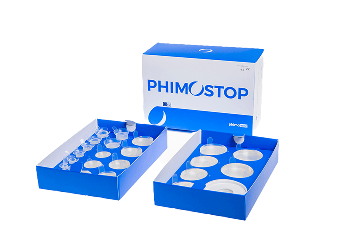
One alternative therapy is the use of ointments or phimosis creams, which aim to soften the foreskin and help it slide over the glans. This is a conservative treatment which, according to the latest scientific research, has proven effective only in cases of mild congenital phimosis in young people. Another method, which is effective even with more severe phimosis and in cases of acquired phimosis, is Phimostop, a medical device validated by the Italian Ministry of Health. Using the natural principle of skin tissue expansion, and thanks to the specific design and patented technology of its specially developed tubes – made from medical-grade silicone – Phimostop halts the progression of scar tissue, gradually returning the foreskin to its original state. The medical device acts on the phimotic ring, stimulating the creation of new elastic cells which, over time, replace those made inelastic by scar tissue.
Treat Phimosis Naturally, Without Surgery
Phimostop is the first European medical device for treating phimosis without circumcision. Using 22 medical-grade silicone tubes, it gradually stretches the foreskin and supports the natural regeneration of the tissue.

When is circumcision the only solution?
As mentioned above, whether or not surgery is the right treatment depends on the type of problem. Circumcision should, in fact, be reserved only for cases of complete phimosis – when the foreskin is so tight that the glans cannot be exposed at all – or for cases of phimosis with complications that can be identified by a medical specialist. Moreover, thanks to Phimostop, it is possible to treat phimosis without surgery. In any case, it is essential to see a medical specialist for a careful assessment of your individual situation and to make an informed decision about whether you need a circumcision. Surgery involves risks and benefits that must be carefully weighed before choosing this solution.
Types of phimosis surgery
There are several surgical options that a urologist can consider, including in the field of plastic surgery.
Classic circumcision or total posthectomy
In a total circumcision, two parallel incisions are made on the portion of foreskin to be removed: the skin is cut down to the subcutaneous layer (dartos), and the blood vessels of the foreskin are sealed using a laser or electric scalpel. Once the excess tissue has been removed, the skin is closed with absorbable stitches. In classic phimosis surgery, a frenuloplasty is usually also performed and, once the operation is over, a semi-compressive elastic bandage is applied. In the days following phimosis surgery, the penis will tend to swell, bleed slightly and be more sensitive. After the operation, wound care procedures are recommended, which are easy to carry out at home over the following seven days. Full healing takes about 4 weeks, after which sexual activity can be resumed.

Partial posthectomy
Partial posthectomy is a surgical procedure that involves the partial removal of the foreskin, the skin that covers the glans of the penis. This procedure is less invasive than total circumcision: on the one hand, it has the advantage of keeping the glans partly covered; on the other, it may carry the disadvantage of possible phimosis recurrence. Healing time before resuming sexual activity is around 3–4 weeks, and using anti-inflammatory ointments can help recovery.
Laser circumcision
Circumcision can be performed using the modern laser technique, which has the advantage of shorter post-operative care. In addition, laser surgery is very precise and makes it possible to cut tissue and seal blood vessels at the same time. As a result, there is none of the typical post-operative swelling caused by traditional surgery. After the operation there is 2–3 days of post-operative wound care, a 3–4 day course of antibiotics (and painkillers if needed), and the stitches dissolve within 7–10 days. Physical activity can be resumed after 2 weeks and sexual activity after 3–4 weeks. Finally, there are a number of plastic surgery procedures that remove the phimotic ring while leaving the foreskin intact; however, these are equally delicate operations and, in most cases, more expensive. In any case, phimosis surgery must be performed with very fine, delicate instruments and requires precision and care to achieve a result that is both functional – freeing the penis from the phimotic ring – and aesthetic, avoiding overly visible and uncomfortable scars. As with any operation, the results depend on how each person’s body responds, especially during the post-operative phase.
Recovery
The hospital stay after phimosis surgery lasts about 24 hours. Immediately afterwards, the patient is discharged with a letter explaining the wound care to be carried out and some measures to follow, such as:
The post-operative phase lasts about 3–4 weeks.
FAQ
Do you have to have surgery for phimosis?
No – in most cases, surgery is not the first route to take. Many specialists suggest exploring conservative options first – such as steroid cream, stretching and dilating rings – before considering surgery. Surgery is generally considered when conservative treatment has not produced the expected results, or when specific complications are present. The assessment is always up to the doctor, who can recommend the most suitable path for each individual case.
How long does the pain last after phimosis surgery?
It is common to have moderate pain for the first 2–3 days after the operation, usually manageable with over-the-counter painkillers as directed by the surgeon. Over the first week, the discomfort tends to ease gradually. After 10–14 days, most people report little or no discomfort. If pain persists or is unexpected, you should contact the surgeon for an assessment.
How many weeks of recovery are needed after circumcision?
Recovery times vary from person to person. In general, for everyday activities and desk-based work, recovery tends to be quick – often within a few days. For strenuous physical activity and sex, it takes longer, and the timing is set by the surgeon based on how healing is progressing. It is important not to rush ahead of the timeframes given by the specialist.
Is partial circumcision better than total circumcision?
There is no universal answer: the choice between partial and total circumcision depends on several clinical factors – including the degree of fibrosis, the underlying cause and the patient’s preferences – which the surgeon assesses in each individual case. In general, partial circumcision tends to preserve more tissue and may give a different cosmetic result, but it may carry a slightly higher risk of recurrence. Total circumcision is permanent. The surgeon is the best person to guide the choice.
Is laser circumcision better than traditional circumcision?
In terms of long-term functional results, the literature generally considers the two techniques to be equivalent. The laser may offer some advantages in terms of less bleeding during surgery and potentially slightly faster recovery, but not all centres offer it and it tends to cost more. The choice between the two techniques also depends on what the centre offers and on the surgeon’s assessment.
Can phimosis surgery be done as a day case?
In most cases, yes: circumcision for phimosis is commonly performed as an outpatient or day-case procedure under local anaesthetic. The patient is discharged on the same day as the operation. In some particular cases, the surgeon may consider a different approach. The details of the procedure are discussed and agreed with the surgeon during the pre-operative stage.
Can I try Phimostop before deciding on surgery?
If your doctor or urologist considers it appropriate for your situation, trying conservative treatment before deciding on surgery is a common and reasonable choice. Phimostop is a non-invasive option that, in some cases, can be a valid alternative path. We encourage you to discuss it with your doctor, who can assess whether your case is suited to a conservative approach or whether surgery is the most appropriate choice from the outset.
Treat Phimosis Naturally, Without Surgery
Phimostop is the first European medical device for treating phimosis without circumcision. Using 22 medical-grade silicone tubes, it gradually stretches the foreskin and supports the natural regeneration of the tissue.