Complete Phimosis: What It Is, Causes and Possible Remedies
Page co-author:
– Dr. Roberto Miano, Associate Professor of Urology, Faculty of Medicine, University of Rome Tor Vergata.
– Dr. Roberto Miano, Associate Professor of Urology, Faculty of Medicine, University of Rome Tor Vergata.
Complete phimosis (also called tight phimosis) refers to a condition in which the foreskin is so tight that it completely prevents the glans from being exposed. It is the most severe form of phimosis and can cause problems when urinating and/or during sex.

On this page:
What is complete phimosis?
Complete phimosis is the most advanced stage of this condition, with the foreskin so severely narrowed that it cannot move at all. This form of phimosis can occur in two ways: congenital, present from birth and sometimes resolving on its own as the child grows, or acquired, resulting from specific causes such as balanitis or lichen sclerosus, which always require targeted treatment. Complete phimosis is associated with various symptoms, including difficulty urinating, a thin urine stream, swelling of the foreskin when urinating, pain in the glans during sex and pus discharge from the urethral opening (the last symptom only occurs if the condition is associated with an infection).
The difference from partial phimosis
The difference lies in whether the foreskin can be pulled back over the tip of the glans. In partial phimosis, the foreskin can be retracted in certain circumstances, such as when the penis is flaccid (not erect), allowing the glans to be partly exposed. In complete phimosis, on the other hand, the foreskin is so tight that it cannot be retracted at all. Understanding this distinction is crucial for an accurate assessment of the condition and for deciding on the most appropriate treatment.

Treat Phimosis Naturally, Without Surgery
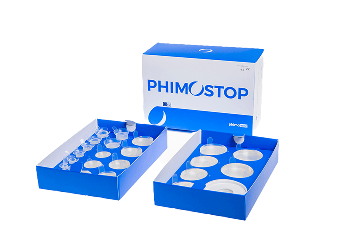
Phimostop is the first European medical device for treating phimosis without circumcision. Using 22 medical-grade silicone tubes, it gradually stretches the foreskin and supports the natural regeneration of the tissue.

Causes
Complete phimosis can be congenital – also known as phimosis in boys and present from birth – or acquired during life as a result of specific causes. Congenital phimosis originates from abnormal development of the foreskin in the womb. Fortunately, in most cases this condition is not serious and tends to resolve on its own as the child grows, usually disappearing by around the age of 10. The causes of acquired complete phimosis, on the other hand, can vary and include:
Risk factors
Several factors can encourage the development of complete phimosis, including:

Symptoms and complications
Complete phimosis shows itself through easily recognisable symptoms, such as:
Severe phimosis can lead to significant complications, including obstruction of the flow of urine and semen. The harder it is to pass urine, the greater the risk of recurrent urinary tract infections. As a result, a person with advanced complete phimosis is more prone to urinary infections. For this reason, complete phimosis should always be assessed by a specialist in diseases of the male genital system. Prompt medical advice is essential to manage the condition properly and to prevent possible long-term complications.
Can you have sex with complete phimosis?
Sexual activity is possible even with complete phimosis, but it requires due caution: in the most severe cases it is not recommended, because intercourse could cause micro-trauma to the scar ring and make the phimosis itself worse. In cases of advanced phimosis, the foreskin can cause pain or discomfort during erection and intercourse. The narrowing of the foreskin can also make it difficult to fully expose the glans, limiting the movement of the foreskin during sex. It is worth stressing that each person’s experience of phimosis is unique, and reactions can vary. Some may put up with the discomfort and choose to stay sexually active despite the condition, while others may prefer to avoid or limit sexual activity until the phimosis has been properly treated. Being aware of your own condition is key to managing the situation thoughtfully and in a way that respects your individual needs.

Diagnosis
To make a diagnosis, the main approach is a physical examination – a targeted medical observation to identify any signs of disease and to build an accurate, complete picture of the patient’s symptoms. Once complete phimosis has been identified, the doctor carries out the investigations needed to find the underlying causes. These usually include:

Available treatments
To treat complete phimosis, the first step can be to apply cortisone-based creams locally to the foreskin. It is advisable to combine this with foreskin stretching exercises. However, if phimosis creams, anti-inflammatory ointments or salves are ineffective, or if the complete phimosis is very severe, traditional treatment involves surgery. Circumcision, performed under local anaesthetic, involves the total or partial removal of the foreskin. It is certainly a definitive solution, but it often fails to take into account a whole range of psychological and physical implications that the patient faces before and after the operation.
How to treat it with the help of Phimostop
Is it possible to treat complete phimosis without surgery? Yes – Phimostop offers an alternative for those who want to cure their phimosis and avoid surgical removal of the foreskin. It is a natural method that uses the principle of tissue expansion to treat complete phimosis without surgery. It does this using medical-grade silicone elements, designed and manufactured to apply skin-stretching techniques to the phimotic ring through gradual, constant pressure. Phimostop is a medical device that can treat every type of phimosis, even the most severe. The device causes no side effects apart from possible discomfort at the application site, and it can also be used for more severe degrees of phimosis, resolving them without the need for surgery.
FAQ
Can complete phimosis be resolved without surgery?
In many cases, moderate forms of complete phimosis respond well to conservative treatments such as topical steroid cream or stretching with dilating rings. These approaches are commonly tried before surgery is considered. However, everyone’s situation is different: some forms – for example those associated with extensive fibrosis or advanced lichen sclerosus – may require a different approach. An assessment by a urology specialist is essential to understand which path best suits your case.
How is complete phimosis different from paraphimosis?
They are opposite conditions. In complete phimosis, the foreskin does not retract: it stays forward over the glans. In paraphimosis, the foreskin has been retracted but cannot return to its normal position, causing a constriction that may require urgent medical attention. If paraphimosis is suspected (swelling of the glans, inability to bring the foreskin forward, severe pain), you should go to an emergency department without delay.
Can complete phimosis affect your sex life?
It is fairly common for complete phimosis to cause discomfort or difficulty during sex, especially in more pronounced forms. Some people report pain during erection or limits on their sexual activity. Treating the phimosis – either conservatively or surgically, depending on your doctor’s advice – generally tends to improve this. If the situation is causing significant distress, it helps to talk to a specialist.
How common is complete phimosis in adults?
Complete phimosis in adults is not a rare condition: the literature estimates that it affects around 1–2% of adult men, with frequency tending to increase in certain age groups and in the presence of conditions such as diabetes. Anyone who notices their foreskin gradually narrowing over time is encouraged to talk to their doctor.
Does complete phimosis get worse over time without treatment?
In some cases, untreated complete phimosis tends to progress over time, especially if inflammatory episodes or micro-trauma that create new scars keep occurring. Specialists generally consider it beneficial to act at a relatively early stage, when the tissue is still less fibrotic. However, every case is different: your doctor is the best person to judge whether and when action is needed.
How long does conservative treatment for complete phimosis take?
The duration of conservative treatment varies considerably from person to person and depends on the severity, the underlying cause and the type of approach used. In general, it requires consistency over time – anywhere from a few weeks to several months – as directed by the specialist. For a personalised estimate, it is best to speak to your own doctor.
Complete phimosis and intimate hygiene: what should you do?
Maintaining good hygiene around the foreskin is important even with complete phimosis. It is usually recommended to wash the area gently with lukewarm water, avoiding harsh or perfumed soaps that could irritate the tissue. Forcing the foreskin back to clean the glans is not advisable, as it can cause micro-trauma. Your doctor or dermatologist can recommend the most appropriate hygiene practices for your specific situation.
Sources:
1. https://www.grupposandonato.it/news/2021/ottobre/fimosi-bambini-cos-e-sintomi-cura
2. https://www.santagostino.it/it/santagostinopedia/la-fimosi
2. https://www.santagostino.it/it/santagostinopedia/la-fimosi
Treat Phimosis Naturally, Without Surgery
Phimostop is the first European medical device for treating phimosis without circumcision. Using 22 medical-grade silicone tubes, it gradually stretches the foreskin and supports the natural regeneration of the tissue.