Partial Phimosis: Symptoms, Causes and Treatments
Page co-author:
– Dr. Roberto Miano, Associate Professor of Urology, Faculty of Medicine, University of Rome Tor Vergata.
– Dr. Roberto Miano, Associate Professor of Urology, Faculty of Medicine, University of Rome Tor Vergata.
Phimosis is a medical condition in which it is difficult or impossible to expose the glans of the penis because the foreskin is too tight. It can take various forms, including partial phimosis. In this article, we look in detail at what partial phimosis is, examining its causes, symptoms and the treatment options available.

On this page:
What is partial phimosis?
Partial phimosis is a condition affecting the end of the penis in which the foreskin, because it is narrowed, does not slide back far enough over the glans during an erection, preventing the glans from being fully or partly exposed as it naturally would be. This problem can be either congenital or acquired. It can be congenital, when it is present from birth and caused by a lack of elasticity in the foreskin, or acquired, developing in adulthood following inflammation or infection of the foreskin as a result of conditions such as balanitis, balanoposthitis and lichen sclerosus.
Partial and complete phimosis: what is the difference?
The term complete phimosis refers to a narrowing of the foreskin so extreme that the glans is almost entirely enclosed within it. This form of phimosis can be recognised immediately with the naked eye. Partial phimosis, on the other hand, occurs when the foreskin can be retracted in certain circumstances – for example, when the penis is not erect – allowing the glans to be partly exposed. Both types of phimosis are commonly associated with discomfort or pain during erection and can predispose to irritation or inflammation because the glans is only partly exposed. A clear understanding of this distinction is essential for an accurate assessment of the condition and for choosing the most suitable treatment, which may vary depending on the specific severity of the problem.

Treat Phimosis Naturally, Without Surgery
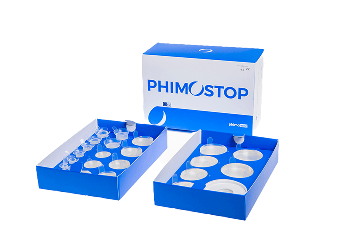
Phimostop is the first European medical device for treating phimosis without circumcision. Using 22 medical-grade silicone tubes, it gradually stretches the foreskin and supports the natural regeneration of the tissue.

Symptoms
Partial phimosis can involve even very mild narrowing, and it is not always easy to notice. This is why it is worth knowing the 5 main symptoms of this condition:

How to deal with it in children
In cases of partial phimosis in children, most doctors advise caution if a child has some difficulty exposing the glans, because in the first years of life this is completely normal and there is no need to worry unduly. This is due to a physiological adhesion between the glans and the foreskin – known as balanopreputial adhesion – which is present at birth in almost all newborns. The percentage of children who struggle to slide the foreskin back to easily expose the glans gradually decreases during the first years of life. After the age of five, it is estimated that close to 95% of children are able to do so. However, since partial phimosis appears during erection, it is difficult to diagnose before puberty, unless there are clear structural signs such as a short frenulum or persistent adhesions between the glans and foreskin. In these cases, the paediatrician may consider referring the child for a urological examination to determine whether appropriate drug treatment or, where necessary, surgery is required. It is important to stress that forcing the glans to be exposed is absolutely wrong, as it only risks causing complications and severe emotional trauma for the child, as well as physical pain.

Can you have children with partial phimosis?
Yes – with partial phimosis it is possible to have sex and conceive children, although depending on each individual situation it may be more complicated than expected. When the narrowing of the foreskin caused by phimosis is very severe, the flow of semen can be obstructed, causing fertility problems that can prevent conception. In addition, poor intimate hygiene caused by difficulty exposing the glans can encourage genital infections: some of these could affect the testicles or the seminal ducts, causing damage that may irreversibly impair fertility.
Can you have sex with partial phimosis?
You can have sex with partial phimosis, but it is important to stress that everyone may react differently to the condition and that – in most cases – it does not allow sex to be fully enjoyed. As we have seen, this condition can present in different ways and at different levels of severity, and in milder cases it may allow an almost normal sex life; however, not being able to fully expose the glans during an erection causes difficulty, pain and discomfort. Using a condom certainly limits forcing and the risk of irritation or injury, because the lack of direct friction against the partner’s genitals limits the foreskin sliding over the glans. On the other hand, it can cause other problems such as reduced sensitivity and, as a result, difficulty maintaining an erection, since most of the pleasure receptors are located at the end of the penis. As a result, most people affected by partial phimosis find themselves with a limited and unsatisfying sex life. This can often have negative psychological effects, leading to feelings of dissatisfaction, anxiety and inadequacy.

How it is treated: the available therapies
The ways to treat phimosis vary according to the severity of the condition and the related symptoms. In cases of partial phimosis, local products such as phimosis creams, anti-inflammatory ointments or salves can be considered first. These aim to counter the chronic inflammatory process and help restore the skin’s elasticity. Applying a cream to the surface of the foreskin can help soften the skin and improve its elasticity, which is particularly beneficial in acquired phimosis with thickened or scarred skin. Traditional treatment involves partial or total circumcision: depending on the type of operation, part or all of the foreskin is removed to make it easier to expose the glans. It is essential to consider the psychological implications the patient may face before choosing to have part of their penis removed, as well as the post-operative consequences. It is therefore important to explore alternatives before proceeding with surgery, for example by considering Phimostop.
Treating partial phimosis with Phimostop
A non-invasive therapy to completely eliminate partial phimosis is Phimostop, the medical device validated by the Italian Ministry of Health and designed to treat phimosis without circumcision surgery:
If the phimosis comes back, the cylinders can be reused after being carefully cleaned.
Sources:
1. https://www.santagostino.it/it/santagostinopedia/la-fimosi
Treat Phimosis Naturally, Without Surgery
Phimostop is the first European medical device for treating phimosis without circumcision. Using 22 medical-grade silicone tubes, it gradually stretches the foreskin and supports the natural regeneration of the tissue.