Phimosis in Boys and Teenagers: Symptoms and Available Treatments
Page co-author:
– Dr. Roberto Miano, Associate Professor of Urology, Faculty of Medicine, University of Rome Tor Vergata.
– Dr. Roberto Miano, Associate Professor of Urology, Faculty of Medicine, University of Rome Tor Vergata.
Phimosis is a condition that makes it impossible to do something natural like exposing the glans, because the foreskin is narrowed and therefore hard to pull back. In childhood and adolescence, this condition is congenital, as it is present from birth, with the foreskin gradually narrowing over the years. It is very common in newborns and children, but tends to resolve on its own over time without the need for medical intervention (in fact, it is called physiological phimosis).

On this page:
The grades of phimosis
There are three grades of phimosis:
Mild phimosis: the glans can be fully exposed. The narrowing is located along the shaft of the penis, making retraction awkward and potentially painful or uncomfortable.
Moderate phimosis: the glans can be partly exposed, and intimate hygiene is problematic.
Severe phimosis: the glans cannot be exposed at all. This makes proper intimate hygiene impossible, predisposing to both local infections and urinary tract infections.
Symptoms
During adolescence, especially in more severe forms, symptoms such as dysuria (difficulty urinating), pain during erections and problems during sex may occur. A common inflammation associated with this condition is balanoposthitis, an infection caused by fungi or bacteria that affects the glans and the surrounding foreskin. Balanoposthitis is characterised by local redness, discharge, swelling and itching.

Treat Phimosis Naturally, Without Surgery
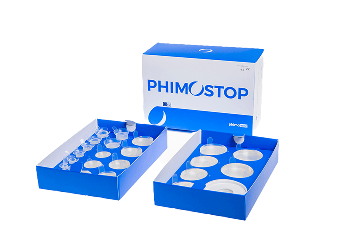
Phimostop is the first European medical device for treating phimosis without circumcision. Using 22 medical-grade silicone tubes, it gradually stretches the foreskin and supports the natural regeneration of the tissue.

“My son has phimosis”: what should I do?
The difficulties and challenges associated with phimosis can affect many aspects of a teenager’s life, including their first relationships. Erections are often painful, making sex problematic because of friction between the genital tissues. Not using a condom can also make things worse, as strain and stress on the foreskin tissue can cause injuries and irritation. A significant risk during sex with phimosis is forcibly exposing the glans, with the phimotic ring then becoming trapped below the corona. This situation, known as paraphimosis, is a urological emergency: if the foreskin is not put back in place quickly, it can strangle the end of the penis, causing gangrene or ischaemic necrosis of the glans. In addition, painful sex can lead to two opposite but equally frustrating outcomes: loss of erection and premature ejaculation. It is therefore very important to book an appointment with a urologist or andrologist to address and resolve the phimosis.
How to get rid of phimosis in young people without surgery
Circumcision for a teenage boy is an option that probably nobody wants to consider. Fortunately, today there are other ways to solve the problem without having to undergo surgery. For milder phimosis, products such as specific phimosis creams, anti-inflammatory ointments or salves may be suggested first – products that aim to counter the chronic inflammatory process and help restore the skin’s normal elasticity. Another option is Phimostop, a minimally invasive product validated by the Italian Ministry of Health and with very high success rates in treating phimosis. The device works by harnessing the natural tendency of tissue to stretch when subjected to constant tension, encouraging the growth of new elastic cells. If the phimosis is mild, treatment can achieve results within a few days; timescales can vary considerably, however, depending on how each person’s body responds, which differs from patient to patient.
FAQ
Does phimosis in boys go away on its own?
In the vast majority of pre-school children, phimosis is a physiological condition that tends to resolve on its own as they grow. Many children who cannot retract their foreskin at 2–3 years of age are able to do so naturally by the age of 10–12. If, on the other hand, the situation persists into adolescence or causes symptoms (difficulty urinating, repeated infections), an assessment by a paediatrician or urology specialist can be helpful. Forcing the foreskin back manually is never advisable, as this can cause micro-trauma and scarring.
At what age is it normal to have phimosis?
In newborns and young children, it is very common for the foreskin not yet to be retractable: this is considered physiological in the first few years of life. As children grow, the situation tends to develop naturally in the vast majority of cases. If no progress is seen by the age of 10–12, or if there are symptoms, it is advisable to talk to the paediatrician, who can assess whether a specialist examination is appropriate.
What happens if phimosis is not treated during adolescence?
Phimosis that persists into adolescence without being assessed can, in some cases, make proper intimate hygiene difficult, encourage recurrent infections or cause discomfort during erections. However, it is important to stress that every situation is different: some mild forms cause no significant problems, while others may need attention. An assessment by a specialist will show whether treatment is needed and which treatment is most suitable.
My son is 13 and his foreskin won’t pull back: should I be worried?
Not necessarily: at 13, some difficulty retracting the foreskin can be part of normal development, especially if it causes no symptoms. However, if the foreskin is completely fixed, or if there are episodes of pain, infection or significant discomfort, a visit to the paediatrician or a urologist is advisable. The doctor will assess the situation and, if necessary, suggest a course of treatment. It is never advisable to force the foreskin back manually at home.
Is Phimostop suitable for teenage boys?
Phimostop is a medical device that works by gradually and non-invasively stretching the foreskin. For use in minors, it must only be used on the advice and under the supervision of a doctor or urology specialist, and with the informed consent of the parents. If you are considering this option for your son, please consult your family doctor first or contact our team for guidance.
Can phimosis in boys cause fertility problems?
Phimosis itself is not directly associated with fertility problems. However, recurrent infections and untreated chronic inflammation could, in some cases, have long-term consequences. Treating any infectious complications promptly is also good practice from this point of view. For any questions about fertility and reproductive health, it is best to see a medical specialist.
What is the difference between complete and partial phimosis in boys?
Phimosis is often described according to how far the foreskin can be retracted. In the tightest (complete) form, the foreskin does not retract at all; in the partial form, it can be retracted partly but not fully. In boys, this distinction can influence the choice of the most suitable treatment: this is why an assessment by a doctor or urologist is essential to understand the specific situation and find the most appropriate path.
Sources:
1. https://www.humanitas-care.it/news/pisellino-chiuso-cosa-fare-e-cosa-non-fare/
2. https://www.ospedalebambinogesu.it/fimosi-89885/
3. https://pubmed.ncbi.nlm.nih.gov/10423888/
2. https://www.ospedalebambinogesu.it/fimosi-89885/
3. https://pubmed.ncbi.nlm.nih.gov/10423888/
Treat Phimosis Naturally, Without Surgery
Phimostop is the first European medical device for treating phimosis without circumcision. Using 22 medical-grade silicone tubes, it gradually stretches the foreskin and supports the natural regeneration of the tissue.